
About Vrnjačka Banja
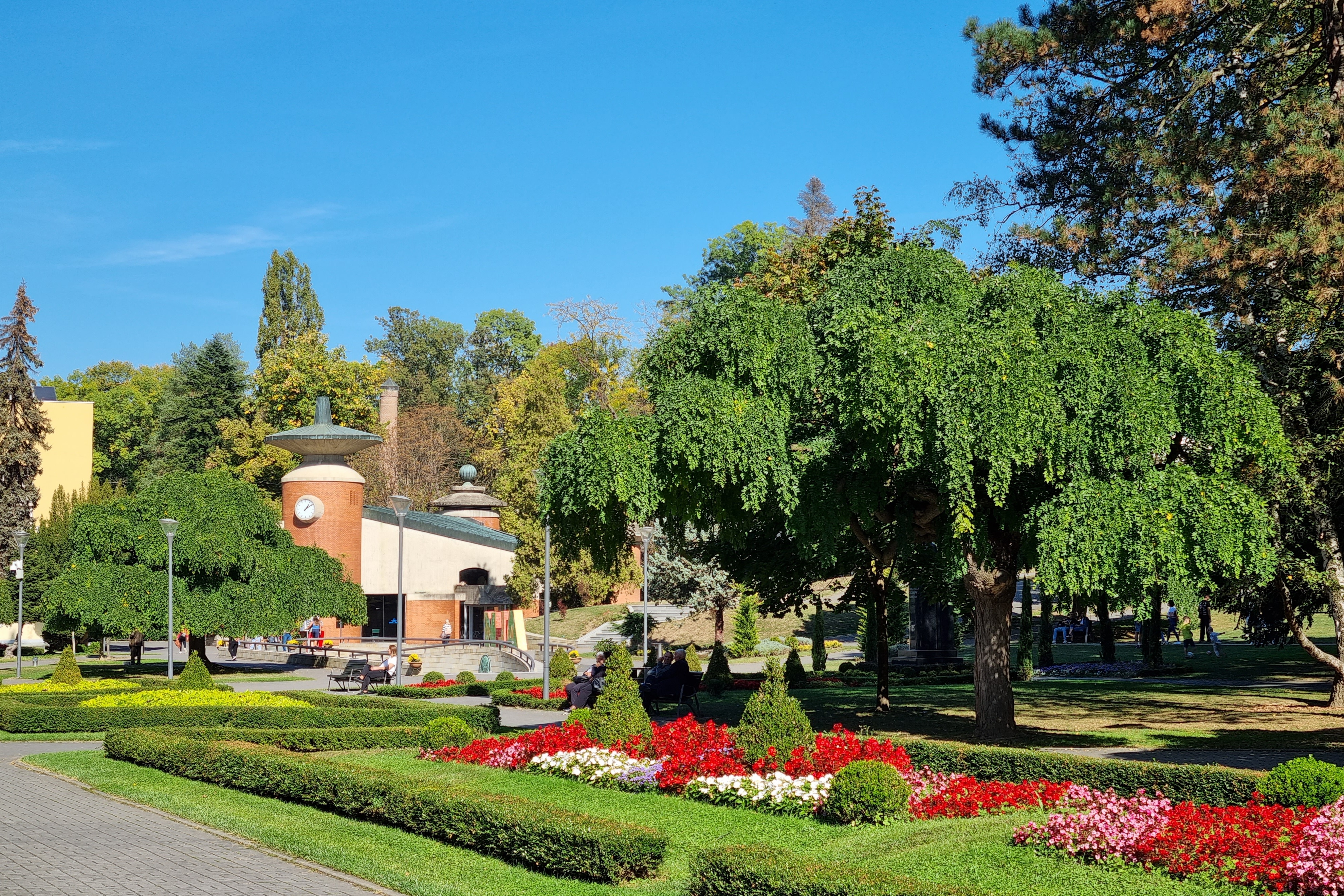
Vrnjačka Banja is the largest and most famous spa in Serbia. With a tradition of organized tourism spanning over 150 years, Vrnjačka Banja has positioned itself high on the list of the most visited tourist destinations in the country and rightfully holds the title of queen of continental tourism.
It is located in central Serbia, about 200 kilometers south of Belgrade. It is located in the valley between Zapadna Morava and the northern slopes of Mount Goč. With its forest-mountainous hinterland consisting of the mountains Kopaonik, Jastrebac, Željin, Stolovi and Goč, it forms a wide area of preserved natural environment. The climate is moderately continental. The influence of the nearby mountains gives the microclimate of Vrnjačka Banja a special character and makes it very pleasant. Summers are moderately warm with fresh mornings and evenings, and winters are snowy and without harsh frosts. The average annual temperature is 10.5°C, and the average summer temperature is 20°C. Easy accessibility is what sets Vrnjačka Banja apart from many other Serbian spas. It is well connected with all other parts of Serbia by highway, road and railway.
In addition to the health resort, thanks to its facilities and rich tourist offer, Vrnjačka Banja has become a modern tourist destination with numerous hotels and Wellness & Spa centers, intended for all types of guests, from business people, through family guests, to sports teams and young people looking for good fun. Numerous festivals are another reason why visitors come to Vrnjačka Banja, making it the most visited in Serbia and the region.
History

Vrnjačka Banja has been known for its healing springs since ancient times. Archaeological finds indicate that this area was inhabited in prehistoric times. The medicinal properties of the water in Vrnjačka Banja were first heard about in the time of the Romans. On the hot mineral spring they built their spa and recovery center "Aquae Orcinae". This is evidenced by the archaeological finds in the narrow core of the Roman spa, i.e. the swimming pool, the Roman source of warm mineral water (Fons Romanus) discovered in 1924, and many coins with the figures of Roman emperors from the 2nd to 4th centuries. Legionnaires of the 5th Legion of Flavian and the 7th Legion of Claudian, as well as the Romanized tribal aristocracy of that era, mostly came for treatment and recovery. It is believed that later the southern Slavs also knew about the healing properties of mineral waters when they settled on the Balkan peninsula. However, little is known about the history of Vrnjačka Banja at that time. It is mentioned that Turkish beys and spakhs used to come to rest in the spa, and the natives then, as legends say, buried the springs from the revolt. Spa tourism in Vrnjačka Banja, as we know it today, began to develop only in the 19th century when, after the liberation from Turkish rule, Prince Miloš Obrenović brought geological experts from Europe to sample and determine the medicinal properties and mineral composition of the waters. In 1835, the Saxon Baron Herder performed the first chemical analysis of Vrnjačka Banja hot mineral water and rated it as very high quality, comparing it to Karlovy Vary in the Czech Republic. However, the spa had to wait another thirty years for modern development.
The core of the spa was built by prominent people from Kruševac, Kraljevo and Trstenik, who joined forces in 1868 under the leadership of the district head Pavle Mutavdžić and formed the "Osnovatelno fundatorsko društvo kiselo vruće vode u Vrnjcima". In the same year, two sources of hot mineral water were collected and construction of health facilities began, primarily baths and spa facilities, and Vrnjačka Banja got its name from the village on which it was located. Already the following year, the healing properties of the waters in Vrnjci quickly became known in what was then Serbia, and learned people of that time, doctors, engineers, architects, began to arrive. Experts in their fields came from Germany, Austria and the Czech Republic, they captured mineral water sources, designed parks in the French-baroque style, built villas and annexes... Thanks to them, the European spirit and culture were permanently established in Vrnjačka Banja. In 1888, General Jovan Belimarković, a very respectable person of that time (Minister of Military Affairs, Interior, Construction and Viceroy during the reign of the minor Aleksandar Obrenović), decided to build a summer house here. The political, economic and cultural elite of the time began to come to the spa with him. Enterprising people from the surrounding towns are building their villas and guesthouses, the central spa area is being renovated and the number of visitors has been growing year by year. During the First World War, Vrnjačka Banja stagnated. In 1915, there were several Allied hospitals located in spa guesthouses and resorts. The wars did not manage to erase the beauty of the spa in Vrnjci, so after the end of the war, the spa flourished. Modern villas, sanatoriums (St. Đorđe, Živadinović) were built, a large hot mineral spring was collected in 1924/25. year, a modern bathroom was built, the Vrnjačka river was regulated, spa parks are being expanded and arranged, roads are being built, and the water supply and sewerage network is being expanded. Cultural life is flourishing, fairs, concerts of serious music are organized, and renowned theaters are visiting. Vrnjačka Banja has been compared to the famous French Vichy Spa, Czech Karlovy Vary and German Baden Baden for the healing properties of its waters, conceptual design, rich parks and authentic architecture. The richest people in Serbia built villas and summer houses here, and some of them are still preserved today. After the Second World War, most of the villas were nationalized, and the spa changed its clientele. There is no longer the splendor and opulence of the elite, but patients are sent to the spa for treatment. In the mid-sixties, new facilities and large hotels began to be built, and in the eighties, the number of visitors to Vrnjačka Banja reached a record high.
Vrnjačka Banja was visited by prince Miloš Obrenović, the royal family Karađorđević, Josip Broz Tito... Ivo Andrić, Desanka Maksimović, Mira Alečković, Danilo - Bata Stojković, Dragan Nikolić, Bata Živojinović, Milorad Pavić, Svetomir Arsić Basara, Milivoje Živanović walked through parks of Vrnjačka Banja. The tradition of 150 years of organized tourism, seven mineral springs, 165 species of rare plants, 1,000 hundred-year-old trees in rows of trees, as well as 60 hectares of landscaped parks and park areas have contributed to the fact that Vrnjačka Banja is today the number one tourist destination for domestic tourists and place of the First tourist category in the country.
Springs of mineral water
Mineral waters have been used since ancient times in various health, preventive and rehabilitation therapies. The characteristics of mineral water have a beneficial effect on the human body, promote relaxation, regeneration and have a positive effect on a wide range of different ailments. Mineral waters contain more than 1 gram per liter of solid matter, biological microelements, free and soluble gases and have appropriate physical properties: temperature - thermal and thermo-mineral waters, radioactivity, so they can be used for therapeutic purposes. There are seven springs of mineral water in the area of Vrnjačka Banja:
- "Topla voda", located in the central spa core,
- "Snežnik", located in the area of the Vrnjačka river,
- "Slatina", in the area of the Lipovačka river,
- "Jezero", in the spa park between "Snežnik" and "Slatina",
- "Beli izvor", near the confluence of Lipovački creek and Lipovačka river,
- "Borjak", upstream from "Snežnik" along the bed of the Vrnjačka river,
- "Vrnjačko vrelo", on the highway Kruševac - Kraljevo.
Among them there are springs of both hot and cold water. For balneological therapy, thermal mineral waters from four sources are used: "Topla voda", "Snežnik", "Slatina" and "Jezero", while some waters are bottled as table mineral waters (Voda Vrnjci and Vrnjačko vrelo).
Mineral spring "Topla voda"

The spring of mineral water "Topla voda" is located in the very center of the spa park, surrounded by numerous flower arrangements that decorate the plateau directly in front of the bath, built for the purpose of making the best possible use of the mineral spring. It represents the oldest and most famous source of mineral water from Vrnjaćka Banja, which, judging by the archaeological finds, was known in prehistoric times, and was then used in the Roman period. "Topla voda" is the first source adapted to spa tourism. Back in 1883, the Kursalon was built, in 1892 the first brick bath, and after the catchment in 1924, a pavilion with a central spring and a gift from King Aleksandar Karađorđević to Vrnjačka Banja - a thermal mineral bath were built. To obtain a new amount of water from 1932-1937. deep drilling was started. A new bivouac was erected in 1975, which was the last major physical change to it. The water from this source is slightly mineralized, slightly acidic, and what is certainly interesting is that it belongs to the group of alkaline carbonic acid homeotherms. The temperature of the water at the source is close to the human body temperature (36.6˚C) and hence the term homeothermal spring. The mineral water from this source gives many positive results in the treatment and, above all, in the prevention of certain diseases, among which we can single out diabetes, which today belongs to the list of diseases of the modern age.
Mineral spring "Snežnik"

At the very end of the promenade, right next to the Vrnjačka river, there is a source of mineral water "Snežnik". Although the healing properties of this spring were known at the end of the 19th century, its use began only in 1916, at the initiative of Austro-Hungarian officers stationed in Vrnjačka Banja, who cleaned the spring and installed a pipe for using the water. After the First World War, this water also began to be used for treatment. Grateful for the healing, the teacher Darinka Cavdarović Telebaković, in 1920, arranged the spring and built a fountain. Since then, the need for water from the spring has only increased, so that works on it have been carried out on several occasions, all with the aim of increasing the capacity of the spring. In 1978/80. recapturing was carried out, and the old pavilions were replaced by a bivette. Today, the source has four boreholes. The water from this source belongs to the group of cold, weakly acidic and weakly mineralized waters, whose temperature at the source is 16.8˚C. There are numerous medicinal properties, but it is definitely recommended to consult a doctor for the best application and utilization.
Mineral spring "Slatina"

In the area of the Lipovačka river, there is a source of mineral water "Slatina", which has greatly contributed to the popularization of spa tourism in Vrnjačka Banja. The water has been known since the end of the 19th century, but after research, the first collection was carried out only in 1923, when a pipe was installed at the source. In 1937, new drilling and recapture was carried out, and a pavilion was built above the fountain, which received water from an old source called "Lula", while the other, new source called "Zid", was located in the wall of the pavilion. Until 1978, there were no exploration works at the "Slatina" mineral water site. That year, exploratory wells were installed, and in 1984, the newly discovered water was piped to the old well, where it was mixed and released at three fountains in the newly built biveta. The water belongs to the group of alkaline-alkaline earth, carbonated cold mineral waters. The water temperature at the source is 14.3˚C. Water from this source is used in the treatment of rheumatic diseases, diseases of blood vessels and injuries, but it is definitely recommended to use it under the supervision of a doctor.
Mineral spring "Jezero"

In the area between the "Snežnik" and "Slatina" springs, on the very edge of the Vrnjački park, there is a "Jezero" mineral spring. It got this name because it was found next to a small lake within the park. Although located in an area with high activity of mineral underground water, this spring was put into use only in 1978, when the first fountain was installed on it. The continuation of the works began in 1985, when a new well was made ten meters from the first one. At that time, a glazed wooden pavilion with a fountain was built, and then in 1989, a new modern biveta was built next to the lake itself. Water belongs to the group of alkaline-alkaline earth carbonic acid hypothermia. It is interesting that the spring "Jezero" is actually a warm spring, with a water temperature of 27˚C at the source, and it is located in a valley between two cold springs ("Snežnik" and "Slatina").
The medicinal properties of the mineral waters of Vrnjačka Banja are used in the treatment of the following diseases:
- diabetes (diabetes type 1, type 2 and complications);
- condition after hepatitis;
- diseases of the gallbladder and bile ducts;
- diseases of the pancreas;
- stomach and duodenal ulcer;
- non-infectious diseases of the small and large intestine;
- diseases of the digestive organs;
- infections of the renal pelvis, urinary bladder and urinary tract.
The treatment is carried out by drinking mineral water in clearly defined quantities, bathing in warm water, inhaling and rinsing. With the help of spa water, numerous classical and modern therapeutic procedures are carried out (hygienic diet, physiotherapy, massage, kinesitherapy, balneotherapy, electrotherapy, paraffin therapy). It is always necessary to consult a doctor when using these waters. Spa treatment is carried out today in the Special Hospital for the Treatment and Rehabilitation of Digestive Organs and Diabetes "Merkur", which deals with all preventive, diagnostic, therapeutic and rehabilitation medicine in the field of gastroenterology, endocrinology and metabolic diseases, urology, respiratory tract, as well as some cardiovascular, gynecological and rheumatological diseases, children's diseases that are indicated for treatment in Vrnjačka Banja and diseases from the field of sports medicine.